Two sessions at NADA Show 2026 set out to explain Gen Z to dealers. We wrote up the first one earlier in this series and spent most of it tracing statistics that turned out to have no source. This is the other one, and it is the opposite kind of document.
Preparing for the Next Generation of Car Buyers, presented by Joey Wheeler and Briana Hopkins of Affinitiv, puts its methodology on slide four: their own consumer survey of more than 1,700 people who bought a vehicle, serviced a vehicle or bought an EV at a dealership between March 2024 and March 2025, with the respondent base split almost evenly across four generations. Every figure in the deck is a cut of that one dataset, and each is shown against a non-Gen Z comparison.
That matters more than it sounds, because once you can see the comparisons, several things everybody believes about young buyers turn out to be wrong.
Four findings that contradict the stereotype
They are not endless shoppers. The received wisdom is that this generation grinds through a dozen dealers. The data says Gen Z visited 2.6 dealerships before buying, against 2.3 for everyone else, and test drove 2.6 vehicles against 2.4. That is a rounding error, not a behavioural chasm.
They care markedly less about whether you have the car. This is the single most useful number in the deck and it runs backwards from every other line on the chart. Asked what drives their choice of dealership, Gen Z rates the vehicle actually being in stock at 37.9 per cent, while non-Gen Z rates it at 56.7 per cent. On price they invert it: 69.8 per cent against 58.6. On your service reputation, 39.1 against 26.6.
A younger buyer will wait for the right car. They will not wait for a straight answer on price.
They want people, not just screens. 51 per cent named the sales associate’s support as the best part of the process. The session is explicit that this is not a digital-replaces-people argument, and the numbers back that up.
The digital enthusiasm is softer than the headline. 79 per cent say they would use digital retailing options, against 57 per cent of everyone else. But that 79 breaks down as 38 per cent extremely likely and 41 per cent only somewhat likely. Half of the enthusiasm is polite. Build for the 38.
The reframe worth taking back to your sales floor
Anti-uncertainty does not equal anti-dealer. Anxiety comes from the process, not the purchase.
The deck’s best slide is a translation table, and it is the thing to photocopy for your sales meeting. On the left, the behaviour. In the middle, what dealers see. On the right, what is actually happening.
- Shops multiple dealers. Dealers see indecision and wasted time. It is regret reduction.
- Delays or pauses the decision. Dealers see overthinking. It is managing anxiety caused by uncertainty.
- Questions pricing and fees. Dealers see price resistance, or a customer who does not value the recommendation. It is refusing to decide without proof.
The emotional data supports it. The purchase process is mostly positive for Gen Z, with 70.4 per cent excited and 64.5 per cent happy, but only 51.5 per cent felt confident and 32.5 per cent were nervous, which is 60 per cent more than older buyers. Nearly a third of your young customers are anxious while buying something they are excited about. That gap between excited and confident is the entire commercial opportunity.
Why this matters for your dealership: if your team reads careful buying as time-wasting, they will handle it badly. Rename it in the sales meeting and the handling changes.
Where the deal is lost
The session maps six stages, research, pricing, visit, decision, service and loyalty, and marks three as the places dealers actually lose people: pricing, the visit, and service. The failure modes named under each are uncomfortably specific. Unclear pricing. The digital journey resetting when the customer arrives. An advisor unaware of the research the customer has already done. Recommendations without proof. Cost without context.
And one quoted line, printed on the slide as the thing not to say: “We’ll explain it when you get here.”
Friction one: opacity
Three sub-frictions, each with a number attached. On pricing, 93 per cent of Gen Z want clear service pricing displayed on the online scheduler. On time, 21 per cent say long purchase times are the worst part. On recommendations, 57 per cent think video evidence is more trustworthy than taking the dealership’s word, and that indexes 22 per cent above Baby Boomers and 11 per cent above Gen X.
Friction three: prove it or lose it
74 per cent of Gen Z say they would approve a repair if shown video evidence, against 53 per cent of non-Gen Z. The full distribution is the part worth knowing: yes 74 per cent, not sure 18 per cent, no 8 per cent.
Only eight in a hundred are a hard no. The other 92 are winnable with a two-minute phone video from under the car.
What actually works
The deck reduces it to what it calls the Gen Z upsell equation: a great service experience, plus a video inspection, plus a reasonable and competitive cost. Underneath sit three principles.
Transparency. Three in four Gen Z and Millennials would add services offered at a bundled discount. 82 per cent would take a less convenient appointment in exchange for a discount. And they are 190 per cent more likely than Baby Boomers to accept extra recommended services when those are generated from similar vehicles at the point of online scheduling.
That middle number is quietly the most valuable line in the session for a service manager. You have a Tuesday morning nobody wants. You have a generation that will take it for a discount. Those two facts have never been introduced to each other.
Digital equals control. Over half prefer online tools for comparisons and negotiations. Broken out: vehicle and payment comparisons 55.6 per cent against 46.7 for non-Gen Z, salesperson and financing negotiations 52.1 against 36.8, augmented or virtual test drives 24.3 against 8.0. And one reversal worth noticing, trade-in appraisal, where Gen Z is actually lower at 24.3 against 26.4.
They want to negotiate from the couch. They still want you to look at their car.
Service drives loyalty. 87 per cent reported a satisfactory service experience, and two thirds will not return after a negative one. The retention split is stark: satisfied servicers are 99 per cent likely to return, dissatisfied 32 per cent. 51 per cent name excellent customer service as the best part of the visit and 22 per cent name high costs as the worst, which the deck answers with a good instruction: show Gen Z why the experience is worth the price.
What changes when you bring this to South Africa
SMS means WhatsApp. The survey names SMS as the preferred channel for dealer interaction. In South Africa that is WhatsApp, and the substitution is not cosmetic: it is where the video inspection gets delivered, where the quote gets approved, and where the reply time is judged.
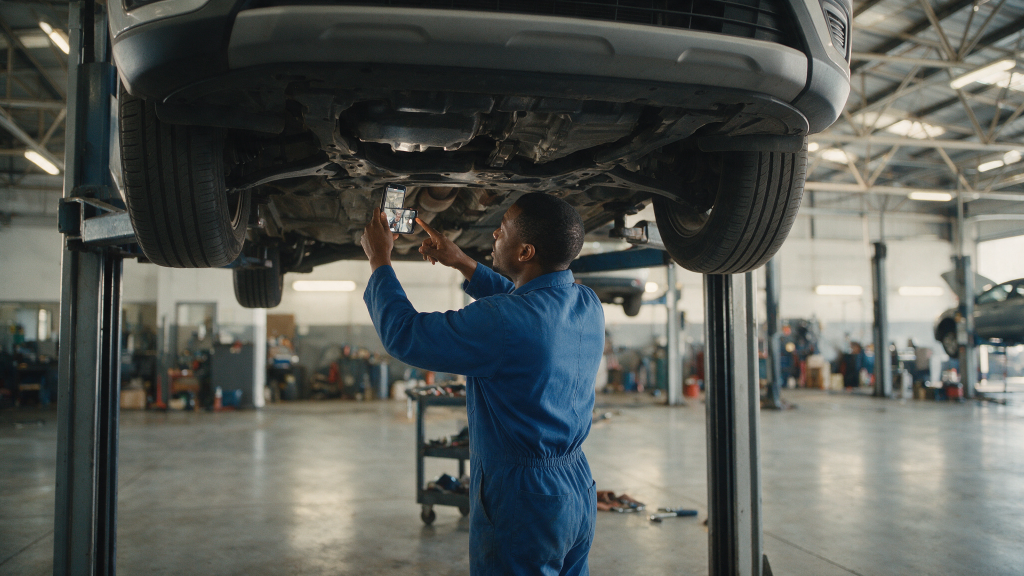
The video inspection is the highest-return thing in this deck, and it is nearly free here. A technician with a phone under a car on a hoist, two minutes, sent on WhatsApp. It converts a repair recommendation from a claim into evidence, and the data says only 8 per cent will still say no. Most South African workshops already have the equipment in their pockets.
The 93 per cent is a bigger indictment here than there. Almost every South African dealer service booking page asks for your details and offers no prices at all. If nine in ten young customers want service pricing on the scheduler, most local dealers are failing the test before the customer arrives.
Delayed maintenance is a bigger problem in this economy. 65 per cent of Gen Z delay vehicle maintenance to stay within budget, and 74 per cent prioritise saving. Against South African fuel, insurance and instalment costs, that number will be worse, not better. The bundled discount and the off-peak appointment are not gimmicks here, they are how you keep a car serviced that would otherwise skip a cycle.
Data-driven recommendations sit under POPIA. The deck is right that this generation is the most comfortable with data being used, but the condition is explicit: as long as it provides value and relevance. Locally that comfort has a legal frame around it. Using service history to generate a recommendation at scheduling is reasonable and defensible. Location-based advertising built on the same data needs a lawful basis and a real consent trail.
The stock finding cuts differently in our market. South African dealers have spent years competing on availability. If younger buyers weight in-stock availability at 37.9 per cent against price at 69.8, then the used-vehicle pricing page matters more than the size of the yard. That is a cheaper problem to fix.
On rands: this deck contains no monetary figures at all, so there is nothing to convert. Every number in it is a percentage from one survey, and the survey is American. Treat the direction as transferable and the magnitudes as indicative.
Where we would push back
It is a vendor’s own survey. Affinitiv sells marketing and retention software to dealers, and every finding points helpfully toward online scheduling, data-driven recommendations and video inspection. The methodology is disclosed, the sample is quota-balanced and the comparisons are shown, which is far more than most conference decks manage. But it has not been peer-reviewed, published in full or replicated, and a survey of 1,700 people cut four ways leaves roughly 400 Gen Z respondents behind some of these percentages.
“Gen Z isn’t the exception, they’re the signal” is asserted, not shown. The closing argument is that improving the experience for Gen Z radiates outward to every other generation, drawn as concentric rings. It is a reasonable hypothesis and we happen to agree with it, but nothing in the data demonstrates it. The survey measures four generations separately; it does not track what happens to Boomer satisfaction when you fix things for Gen Z.
Some comparisons are relative and read as absolute. The 190 per cent figure is a relative lift against Baby Boomers on a fairly narrow measure, not a share of Gen Z. Worth knowing before it lands in a board pack.
What to do this month
- Put service pricing on your online booking page. Even a range beats “contact us”, and 93 per cent of your future customers are asking for it.
- Start video inspections this week with the phones your technicians already carry, and send them on WhatsApp. Measure approval rates before and after.
- Price your least popular workshop slots at a discount and offer them explicitly. 82 per cent will trade convenience for money.
- Read the behaviour translation table to your sales team and ask them which column they have been operating from.
- Fix the handover: make sure the person greeting a customer can see what that customer already looked at online.
- Ban “we’ll explain it when you get here” from your enquiry responses.
- Keep the trade-in appraisal in person. It is the one step this generation does not want to do online.
The honest summary
This is the best-evidenced session we have covered from the show, and the contrast with the other Gen Z talk is instructive. Both arrive at roughly the same advice: publish prices, prove your recommendations, respect people’s time, treat service as the loyalty engine. One got there with ten unsourced statistics and the other with a disclosed survey and a comparison group.
Which rather suggests the conclusions were always right and the first deck never needed to invent anything.
The most useful thing here is not a Gen Z insight at all. It is that anxiety comes from the process rather than the purchase, that only 8 per cent of people refuse a repair once they have seen the evidence, and that a discount on an unwanted Tuesday slot fills a bay. None of that requires new software. It requires publishing a price, filming a video and answering quickly, which is what every generation has wanted and only this one is measured demanding.
If you would like help putting service pricing online, setting up video inspections on WhatsApp, or working out what your own enquiry data says about the buyers you are losing, get in touch.
This is the eighth piece in our series on NADA and ATD Show 2026. Read it against Shift Happens, which covers the same generation with rather less evidence, and alongside Jumpstarting Your Sales Team’s Social Media, The Age of AI Search, 6 Marketing Mistakes and How AI Solves Them, Disrupt Yourself Before the Market Disrupts You, Leading With Emotional Intelligence in the AI Age and Driving Service Revenue With AI and CDP Advertising.
Source
- Joey Wheeler, Vice President Product, and Briana Hopkins, Product Manager Reporting Applications, Affinitiv, “Preparing for the Next Generation of Car Buyers”, NADA Show 2026, Las Vegas, 3 to 6 February 2026.
- All figures are from Affinitiv’s own annual consumer survey as stated on the session’s methodology slide: more than 1,700 consumers who purchased a vehicle, serviced a vehicle or purchased a fully electric vehicle at a dealership between March 2024 and March 2025. Respondent base: Baby Boomers 27 per cent, Gen Z 25 per cent, Gen X 24 per cent, Millennials 23 per cent. The survey is American and has not been independently published or replicated.
- Written from the deck and from the session recording. The paired chart values were read off the recording, because the handout’s text layer does not preserve which figure belongs to which series. The session audio could not be transcribed on our equipment, so this covers what was on screen rather than everything that was said.
- The deck contains no monetary figures, so there was nothing to convert into rands. The WhatsApp, POPIA, South African market and economic commentary, and the three points under “Where we would push back”, are ours and not the presenters’.