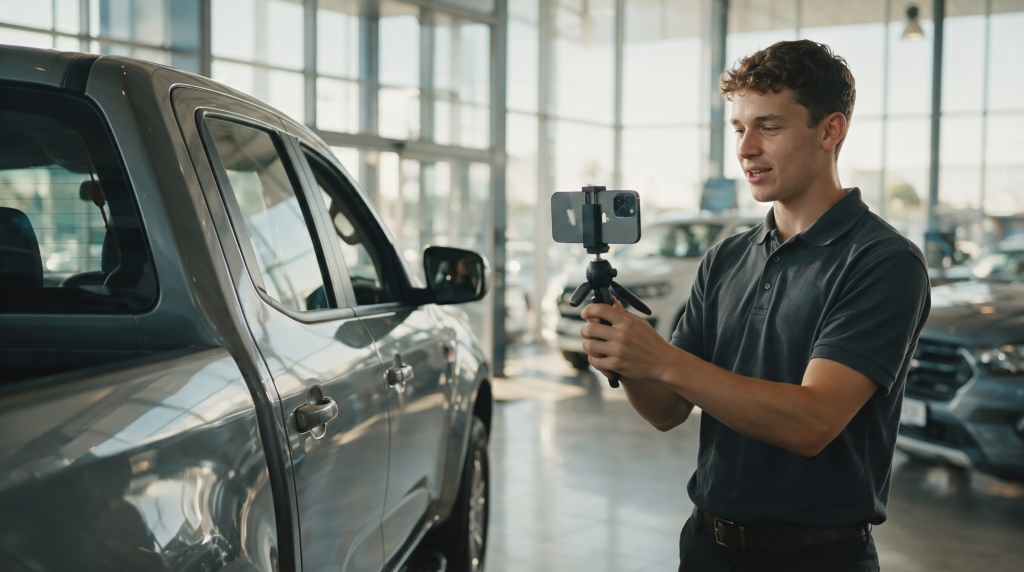
Of the NADA Show 2026 sessions we have worked through, this is the one closest to what we do all day. Exposing 6 Marketing Mistakes & How AI Solves Them was presented by Jorge Lafosse, Director of SEO at Dealers United, alongside Bobby Sight, Managing Partner at Rob Sight Ford in Kansas City. An agency practitioner and a dealer who has actually done the work, which is a better pairing than most conference sessions manage.
It is also the most immediately usable, because it comes with prompts you can run this afternoon. Worth noting that the handout and the session are not the same thing: on stage the two of them put real screenshots up, their own and other dealers’, and several of the best moments never made it into the printed version. Those are in here.
Because this is our own discipline, we have been harder on this one than on the others in the series. There are two places where the advice, followed literally, would make things worse. They are flagged near the end.
Start with the 60-second audit
The session saves its best idea for last. We are going to open with it, because it takes a minute and it tells you which of the six mistakes is actually yours.
Open ChatGPT, Gemini or Google’s AI mode and ask what a buyer would ask:
“What are the best [your brand] dealers in [your city]?”
In South African terms that is “Which are the best Toyota dealerships in Pretoria East?” or “Where should I buy a used bakkie in Durban North?” Then read the answer against the diagnostic:
- You are not mentioned at all. That is mistake two: you are invisible to AI search.
- You are mentioned but the details are wrong. That is mistake one: your messaging conflicts across channels, so the model has assembled something inaccurate out of the pieces.
- A competitor dominates the answer. That is mistakes three and six: thin content, and guessing at what buyers want.
- The answer looks good. You are ahead. Move on to video and amplification.
Run it a few times and in more than one assistant. The answers vary, and the variation is itself information.
Mistake one: telling disjointed stories
Disconnected messaging breaks the shopper journey, and the session made the point with a before and after rather than a bullet list.
The “before” was an anonymised dealer shown across four screens at once. The website led with a no-nonsense, one-price, negotiation-free promise. The Facebook post was a stock photo captioned “find your dream car this weekend”. The Google Business Profile was pushing a 72-hour sale and brake pad discounts. The YouTube channel was running something else again. Four channels, four different dealerships, as far as a buyer or a language model can tell.
The “after” was Rob Sight Ford’s own four screens, all saying the same thing: top rated Ford dealer, thousands of reviews, here since 1923.
The fix is an audit you can run yourself. Paste your website about page, your Facebook ad copy, your Google ad headlines and your recent social posts into one prompt and ask an assistant to identify the conflicts. Then ask it to build a unified message that works across all of them.
In our experience the conflict is rarely dramatic. It is that the website promises a considered, no-pressure experience while the ads shout about a deal that ends Saturday. Both are true. Nobody has ever put them side by side.
One practical tip from the stage that is not in the handout: use the Projects or Folders feature in your AI tool to build up a standing file about your dealership, so you are not re-explaining who you are at the start of every prompt. Small thing, saves an enormous amount of time.
Why this matters for your dealership: a model reading your brand across six channels is doing what a buyer does, only faster and with less charity. Inconsistency does not read as variety. It reads as unreliability.
Mistake two: you are invisible to AI search engines
This is the heart of the session. The term is GEO, generative engine optimisation, and the argument is that dealers are still chasing page one for “Ford dealer Kansas City” while buyers increasingly ask an assistant instead.
The problem slide was a real search results page for dealerships in a mid-sized American town, with the organic block ringed in red. What was ranking was not dealerships. It was the manufacturer’s own site, Carfax and CarGurus. Every South African dealer will recognise the local version, where the aggregators and the OEM sit above you for your own category.
Then the contrast: an AI assistant asked the same question in Kansas City put Rob Sight Ford first, quoted its star rating and review count, and cited Carfax as the source. The dealer did not win by outranking Carfax. It won by being what Carfax says.
The Athletic Greens example
The sharpest thing in the whole session is a slide that is not in the handout at all, and it is worth the price of admission on its own.
Athletic Greens, the supplement brand, does not rank especially well in traditional organic search. It is mentioned constantly on podcasts, most famously by Joe Rogan. AI systems have crawled those episodes. So when you ask an assistant about greens powders, it recommends Athletic Greens, because the brand is everywhere in the material the model learned from.
The line on the slide: no backlinks needed, just brand mentions.
That is the whole of GEO in one example, and it reframes the work. You are not trying to acquire links. You are trying to be discussed. For a South African dealership the places that happens are not the ones an American deck would list: local news sites, community Facebook groups, motoring forums and Facebook Marketplace conversations, club and school sponsorship pages, the regional directories that still rank here, and local radio and podcast appearances. That is unglamorous local PR, and it is now an SEO channel.
Why this matters for your dealership: GEO is not a new department. It is your existing SEO and local search work judged against a different question. Not “do we rank” but “would a model quote us, and what would it cite”.
Mistake three: thin content that adds nothing
The claim is that most dealer content is interchangeable, that AI systems skip over generic material, and that customers cannot tell from it why they should choose you. A figure is attached: 73 per cent of dealer content is indistinguishable from competitors.
No source is printed for that number and we have not been able to trace one, so treat it as the presenters’ characterisation rather than research. The point survives without it. The examples on the slide made it better than the statistic did: a dealership page posting “happy National Radio Day”, and two near-identical “why just browse when you can experience” test-drive posts over stock photography.
The useful part was a side-by-side. Thin: a short, generic blurb about how much a pickup can tow. Authoritative: a full brief for a 3,000-word article answering a specific tax question about that same vehicle, covering deduction limits, weight classifications, cab style and trim level. Same vehicle, same dealership, entirely different value.
The prompt they suggest asks for the top ten most researched questions about a given model in your city, including technical specifications, comparisons, local considerations and buying decision factors. That prompt is good, and the “local considerations” clause is the part that matters, because it is the only element a competitor cannot lift from a manufacturer press release.
Mistake four: treating video as optional
Bobby Sight’s section is the most practical part of the session, because he is describing what his own dealership does. The four failure modes will be familiar:
- Not using video at all, still posting static inventory photos.
- Only using manufacturer assets, with no dealership branding or personality.
- Recycling the same thirty-second television commercial across every digital platform.
- Making videos with no strategy: random walkarounds that do not convert.
What his dealership makes instead: “why buy here” authority videos, award and accolade credibility builders, local community content tied to the city’s football team, customer reviews and testimonials, and walkarounds for both the fast sellers and the units that are not moving.
The scripting formula is worth writing down. They call it HVC-CTA, and the timings are tight: hook in one second, value for twelve to twenty seconds, credibility for five to eight, call to action for three to five, brand statement for two. Roughly thirty seconds, with the first second doing the heavy lifting. The workflow is to have AI generate twenty-five video ideas, script your favourites to that formula, then turn each script into a six-shot storyboard with a twenty-minute filming plan.
Watch what fills the credibility beat in their own example: a Google review card showing 4.8 stars from around 2,900 reviews, a top-rated dealer badge, a local award, and the founding year. None of that is copywriting. It is proof they already had and simply put on screen.
The tools named on stage for cutting and repurposing, which are not in the handout, were Descript, Mirage by Captions, OpusClip and Munch. All four do broadly the same job of turning long footage into short captioned clips, and all four have free tiers worth testing before anyone signs anything.
The line we would put on the wall is the one about production values: do not agonise over how you are going to film it, because simple works as long as you publish and distribute it.
Why this matters for your dealership: a twenty-minute filming plan is the difference between a video strategy and a video intention. Most dealerships do not lack ideas. They lack a slot in the week when somebody stands in front of a car with a phone.
Mistake five: letting assets die on one channel
The pattern is publish on the website, share once on Facebook, start again. What AI sees, in their phrasing, is one mention, limited authority, easy to ignore.
The worked example on stage was better than the theory. They took one real Rob Sight Ford blog post about safe winter driving and showed where it had gone: an email newsletter, a podcast episode, a YouTube video, and a set of social graphics. The podcast episode on the slide was number 102. That number is the actual lesson. This is not a campaign, it is a habit, and it has been running long enough to produce a hundred episodes.
They call the result the citation multiplication effect, illustrated with an Agent Smith still and the caption “content is a virus”. The tool named for automating the distribution was Repurpose.io.
One correction to the mechanics, and it matters. Posting repurposed dealership content to Reddit, Quora and similar communities is against the rules of most of them, and it is the fastest way to have your brand associated with spam. Those platforms are worth being present on, as a person who answers questions, not as a distribution channel for a blog post.
Mistake six: guessing what buyers want
The last mistake is planning content on instinct rather than data, and the session illustrated it with a two-column slide that is worth stealing outright.
On the left, what dealers think customers want: the public holiday post, the tent sale, the announcement that the new model has arrived. On the right, what customers actually ask: what does it really use on fuel, what will insurance cost for a teenager, what will this vehicle cost me to keep over five years.
Translate that column to South Africa and it barely changes. Dealers post about the Black Friday deal and the launch event. Buyers want to know what a bakkie genuinely uses per hundred kilometres on the N1 rather than the brochure figure, what a nineteen-year-old on the policy does to the premium, what the service plan actually covers and what happens when it ends, and what five years of ownership costs all in.
Almost nobody publishes those answers, because they are awkward and specific and they take real knowledge to write. That is precisely why they work.
The market intelligence examples elsewhere in this section, searches for a category up by some large percentage and so on, are illustrations of the shape of a finding rather than measurements of any real market. Read them that way.
Why this matters for your dealership: you already own the best version of this data and nobody is reading it. Your Google Business Profile questions, your website search box, and the questions your sales team answers on WhatsApp forty times a week are a free content plan.
What changes when you bring this to South Africa
The frameworks travel. Several of the specifics do not, and one of them is a trap.
The tax example does not translate, and you should not let AI translate it. The session’s flagship piece of authoritative content, shown twice, is an article answering whether a particular pickup qualifies for a Section 179 deduction, quoting a dollar limit. Section 179 is American tax law and the figure is meaningless here. The equivalent question a South African business buyer genuinely types is about SARS wear and tear allowances, or whether the VAT on a double cab is claimable, and the answers turn on the rules and on the buyer’s own circumstances. This is exactly the content an assistant will write confidently and get wrong. If you publish in this territory, write it with your accountant, date it, and review it every February.
Our seasons are not theirs. Their evergreen seasonal asset is winter driving and tyre fitment. That is close to meaningless in most of South Africa. Our calendar is the December holiday trip check, aircon servicing before summer, wet weather and tread depth through a Highveld storm season or a KwaZulu-Natal summer, and the long weekend run to the coast. Same idea, entirely different year.
Community content is local, and it is stronger here. Rob Sight Ford leans on its city’s football team. Your equivalent is the club you already sponsor, the school sports day, the local charity drive, the fleet or taxi association you service. South African buyers respond to visible local commitment, and it is the one thing a national competitor cannot copy.
The channel mix is different. Reddit, Medium and Quora carry far less weight here than in the United States. WhatsApp carries far more, along with community Facebook groups and local motoring pages. Build your amplification list around where South Africans actually are.
Data cost shapes video. Keep it short, shoot it vertical, and subtitle everything, because a meaningful share of your audience is watching on mobile data with the sound off. Here that is not a refinement, it is the format.
Watch the claims. If AI is drafting your vehicle descriptions, pricing lines or finance messaging, the Consumer Protection Act does not care that a machine wrote it. A specification error or an unqualified price is your dealership’s problem. Somebody signs off every line before it goes out, and the American zero deposit, zero interest, zero payments style of offer does not survive translation into a South African finance ad without a compliance conversation first.
Where we would push back
Two things here, followed literally, produce the opposite of what the session promises.
The long-article prompt contradicts mistake three. The session diagnoses thin, interchangeable content, then hands you a prompt asking AI to write a comprehensive two thousand word authoritative article. Run that prompt cold and you get exactly the material mistake three warns about, only longer. What makes content citable is not length. It is something that could only have come from you: your stock, your prices, your market, your workshop’s experience of what actually breaks on that model at 120,000 kilometres. Use AI for the structure and the research pass, then put in the part only you know. If nothing in the draft required your dealership to exist, delete it.
The citation multiplication effect has a ceiling. Getting the same core message onto twelve platforms is sound. Getting the same text onto twelve platforms is a different thing, and search engines and communities have both spent years learning to spot it. Repurpose the substance and rewrite for the room. Their own worked example, incidentally, does this properly: the podcast episode is not the blog post read aloud.
What to do this month
- Run the 60-second audit today, in two different assistants, and write down which of the six mistakes the answers point at.
- Do the channel audit. Paste your website about page, ad copy and recent social posts into one prompt and ask where they disagree.
- Fix your Google Business Profile before anything else. It is the cheapest authority signal you own, it is what the assistants quote, and it is usually out of date.
- List every place your dealership gets mentioned locally that is not your own website. That list, not your backlink profile, is your GEO starting point.
- Book one twenty-minute filming slot a week, permanently, and shoot to the hook, value, credibility, call to action, brand format.
- Take your best-performing page and rebuild it as a video, a set of short clips and an email before you write anything new.
- Ask your sales and service teams for the ten questions they answer most often. That is your content plan, and it cost nothing.
The honest summary
This was a vendor-adjacent session, presented in part by an agency that sells the service it recommends, carrying one unsourced statistic and a set of illustrative numbers that could be mistaken for findings. Worth knowing before you quote it in a management meeting.
Set against that, it is the most actionable thing we have watched from the show. The six mistakes are real, the diagnostic at the end genuinely works, the Athletic Greens example explains generative search better than most agency decks manage in an hour, and the video and repurposing sections come from a dealer who does the work rather than sells it. A South African dealer group that ran only the two audits this month and booked the weekly filming slot would be ahead of most of its competitors by March.
The uncomfortable part is that almost none of it is really about AI. It is about publishing consistently, saying something only you can say, and putting it where people already are. AI makes that faster. It does not make it optional.
If you would like us to run the audit on your dealership and show you what the assistants are currently saying about you, get in touch. It takes us an afternoon and you get the findings either way.
This is the fourth piece in our series on NADA and ATD Show 2026, alongside Disrupt Yourself Before the Market Disrupts You, Leading With Emotional Intelligence in the AI Age and Driving Service Revenue With AI and CDP Advertising.
Source
- Jorge Lafosse (Director of SEO, Dealers United) and Bobby Sight (Managing Partner, Rob Sight Ford), “Exposing 6 Marketing Mistakes & How AI Solves Them”, NADA Show 2026, Las Vegas, 3 to 6 February 2026. Written from both the session handout and the recording. Several items here appear only in the recording, including the Athletic Greens example, the before-and-after channel screenshots, the thin-versus-authoritative comparison, the named video and repurposing tools, and the two-column slide on what buyers actually ask.
- The 73 per cent content claim is the session’s and carries no source. The market-intelligence percentages are illustrative examples in the deck, not measurements. The handout’s link to a fuller prompt pack no longer resolves. Dealerships shown as negative examples on stage are not named here.
- The session carries no monetary figures to convert for a South African reader apart from a United States tax deduction quoted inside a worked content example, which is discussed above rather than converted, because the South African equivalent is a different rule and not a different number. The South African channel, seasonal, community, data-cost, Consumer Protection Act and finance-advertising commentary, and the two points under “Where we would push back”, are ours and not the presenters’.